

Before we start:
You still have 2 more days for getting 15% off both Euro Top Tech and Remote Compass.
Claim your discount HERE for ETT.
And for Remote Compass, just use the discount code BLACKFRIDAY at checkout.
The article I published yesterday is in my opinion of the best I’ve ever written.
If you haven’t checked it out yet, and are interesting in remote work, relocations, countries assessments etc, make sure to take a look.
Now, let’s get into some updates
1. Euro Top Tech’s Discord Community
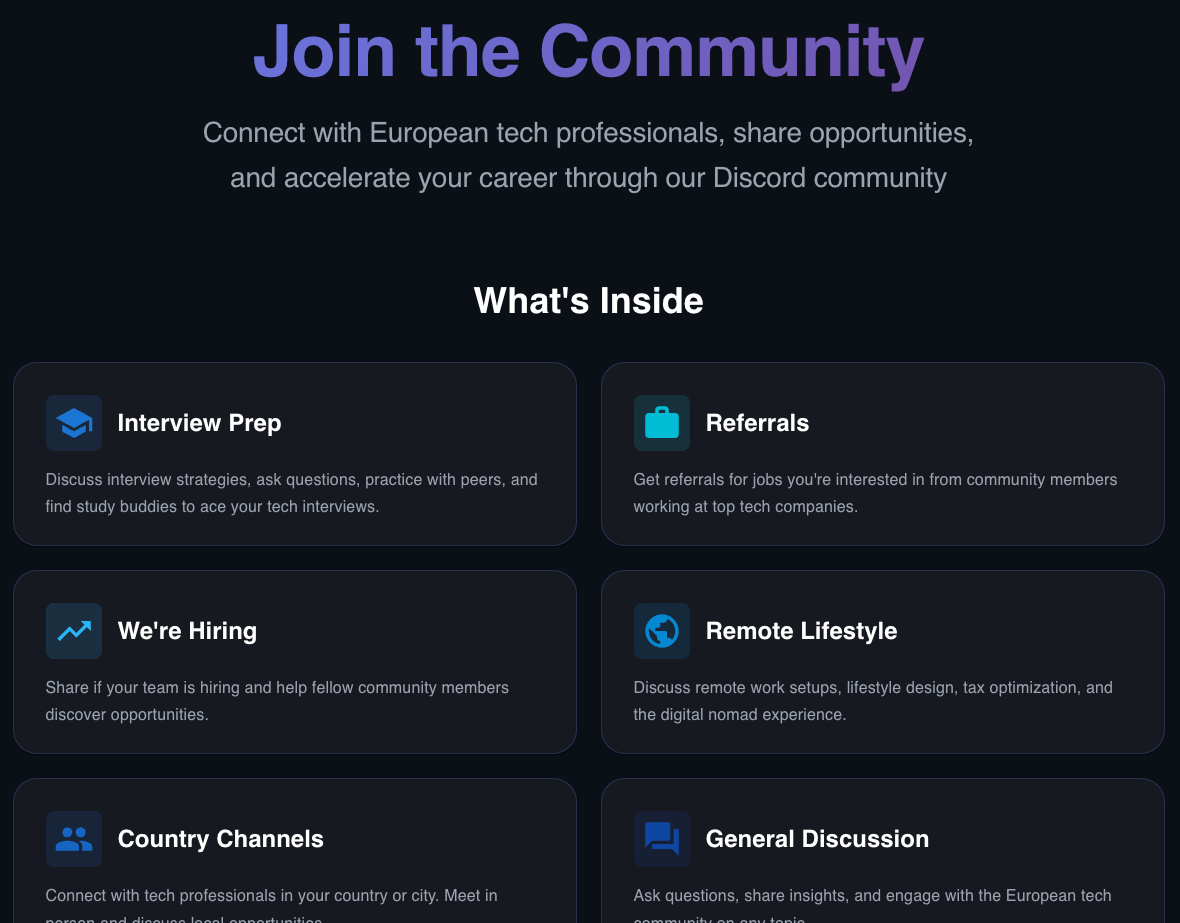
1.1. One thing I created this week is a CV Reviews channel
Where I, or others in the community - including people who’ve went through my coaching program-, can give some tips on people’s CV
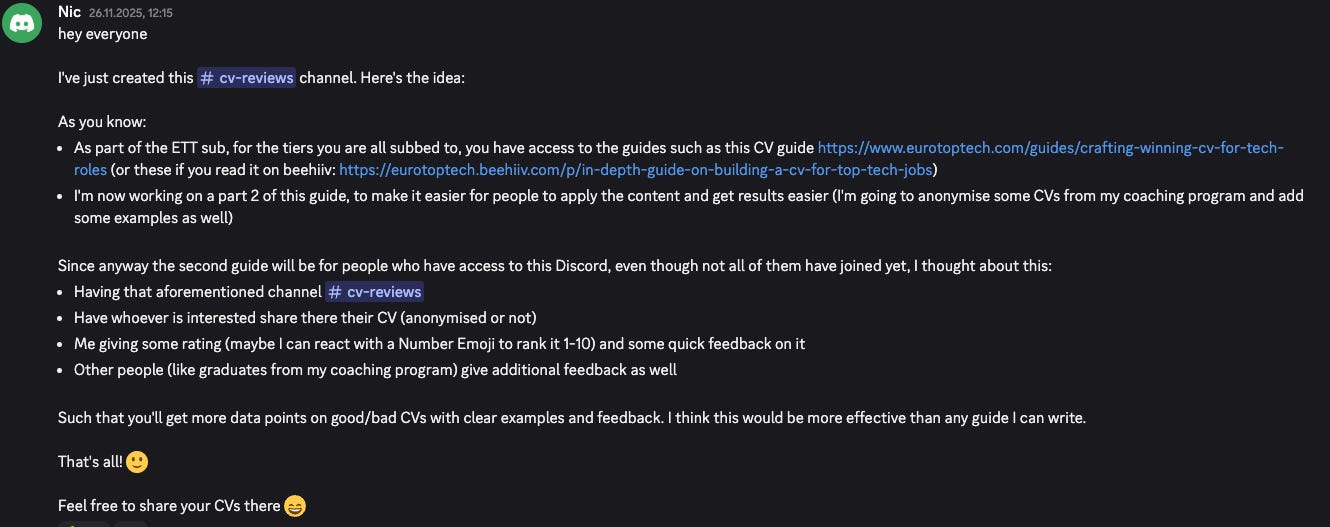
This is an example of a CV I’ve reviewed
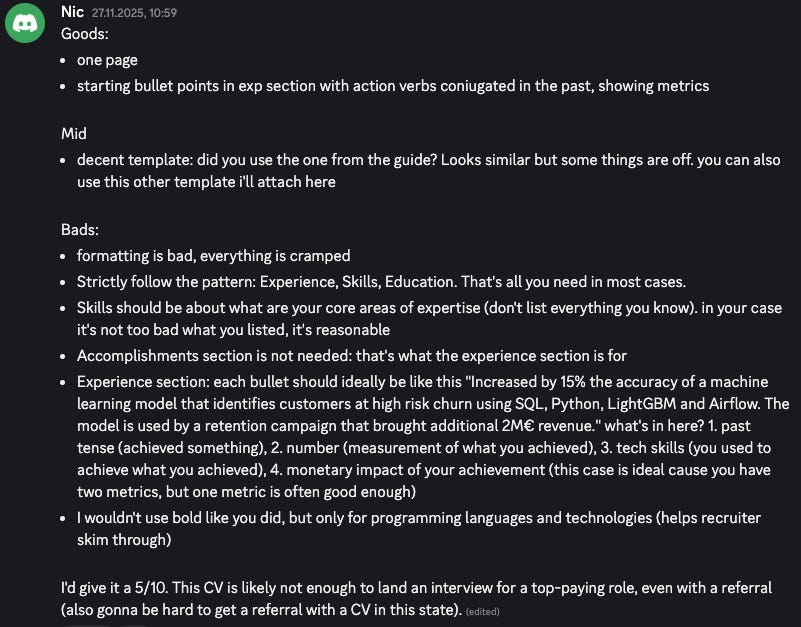
1.2. Posting jobs with recruiter/hiring manager info
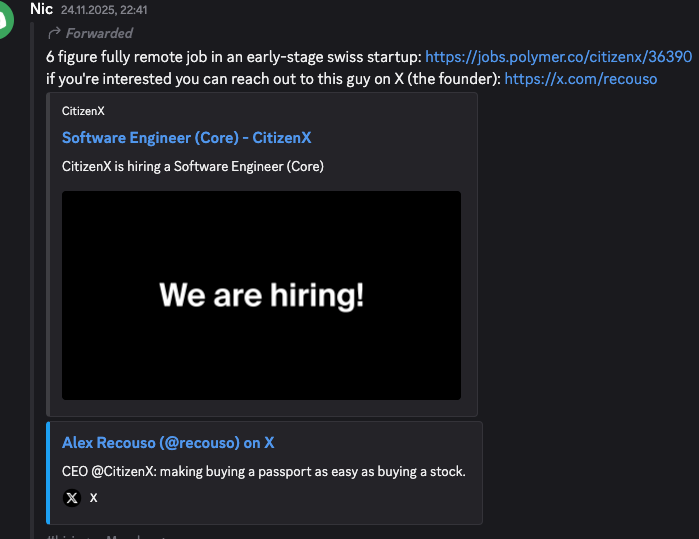
1.3. Some discussions on interview prep
Like what’s the role of LeetCode-style interviews in 2025/2026, and which (good) companies still ask this type of questions.
2. Coaching Program
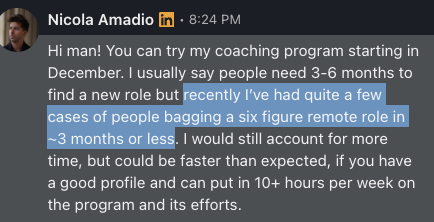
I’ve been realising that the majority of people landing a six-figure remote roles within the program, usually do it in about 3 months.
At least that’s what I’ve seen in the past 6 months.
It’s quite strange, if you ask me. As I think 6 months are usually necessary.
Here’s a few things I’ve noticed from a few such cases:
2 Senior backend/fullstack devs
Joined the program knowing they want a remote role, 100k+
We do the usual coaching program work (brainstorming, finding vertical and target companies, working on CV, LinkedIn and networking, doing interview prep, etc)
They end up with an interview from one of
Personal contant
Recruiter reachout via LinkedIn
Application with or without referral
They pass the interview
Get the offer
All in 3 months.
Some things they shared:
Marketable profile: backend/full-stack seems to still be the most versatile profile for 6-figure remote roles.
Clear goals: not much time investment on “finding my path” → they enter with a clear goal, we narrow down the goal and create a streamlined strategy, they progress quicker.
Good work ethic: 10+ hours per week dedicated to the coaching program.
Experienced (5-10 years of exp): once they land the interview, they are likely to get the job → they usually don’t need many interviews / companies replying to their application.
Recently, I’ve been coaching a guy who joined 2/3 months ago:
Profile in DS/ML
~5 years of exp
Needed brainstorming and iterations on which industries/roles/goals to target
Yet:
Very hard-working: 10-15 hours invested per week
Smart and good/fast at executing on the learnings from the coaching
Currently interviewing for a 150-200k remote role
So, what are the learnings:
IMO
Hard work is mandatory: 10+ hours per week
Goals need to be realistic: 100k+ remote only with some years of exp (if less experience, program can still work but goals need to be adequate)
Being in a good domain matters: FS/Backend > DevOps >= DS/ML >= Crypto > Frontend > Embedded etc
Approach needs to be practical: brainstorming only if really needed, if done it needs to be quick and momentum/progress needs to start early
Being good a the job and having some experience helps passing interviews: the higher your interview-success rate, the fewer interviews and job processes you need
And, the most important:
Despite all that people say online: high-paying remote tech roles are still very, very much attainable
I always have so much fun working with such people that fit the above criteria.
It’s a joy to work together and see career directions crystallising and becoming clear, getting to learn from each other and see them progress, and finally see them achieve such life-changing goals thanks to landing much better jobs and career success/confidence.
If you’ve been thinking of joining the program, now it’s a GREAT time to start.
Why?
January, February and March see the highest headcount of the calendar year
This means that teams have more resources, and there’s more job openings
Most people are slow and spend Christmas holidays chilling, and think about working on their CVs in February
If you start earlier and are already sending well-formatted CVs with a referral by Jan/Feb, and have done interview prep by March/April, you’ll have a strong competitive advantage
Checkout the program description here, and feel free to fill in the form at the end of the page if you wish to apply (I only accept to work with people where I have a high confidence that I can help them achieve the desired results).
3. Romania?

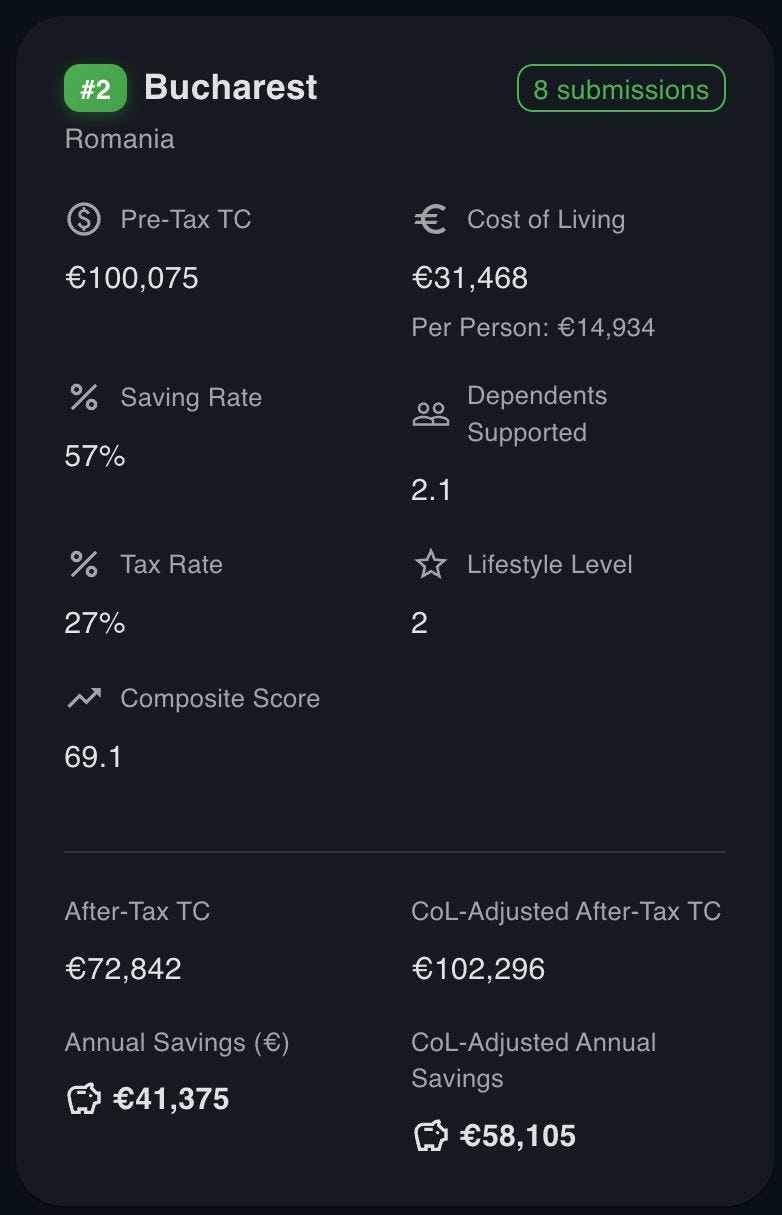
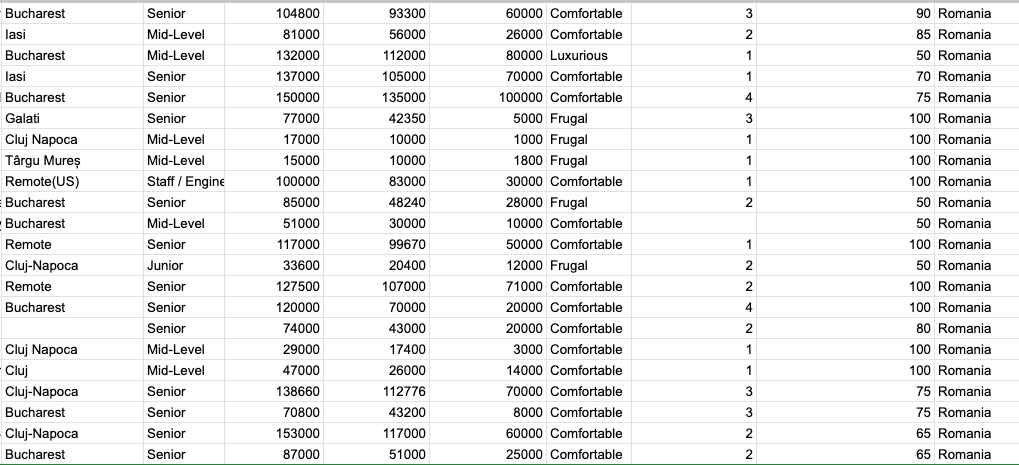
Form to contribute: https://docs.google.com/forms/d/e/1FAIpQLScWDzXlEnniMDUG8lQYwzL8Y1w1iRLlFujhQEVr4G_sGGqTvQ/viewform
Site to see full stats: https://www.eurotoptech.com/financial-data
This article is brought to you by:
Remote Compass - The #1 AI SaaS to find a place to live
Decide where to live with data, not guesses.
Input your lifestyle constraints, compare countries with frontier AI models, and chat through the trade-offs before you pack.
Euro Top Tech - The #1 SaaS for top-paying tech careers in Europe:
2000+ top paying tech jobs in Europe from big tech companies, HFT firms and high-paying scale-ups.
1000+ jobs from 100+ fully-remote companies paying $100-600k per year.
Private guides - like this one - to help you land these jobs.
Six Figure Euro Engineer - Maxx your pay and lifestyle as a tech worker in Europe:
Work 1:1 with me (Nicola Amadio, author of this newsletter), and join the other engineers who were able to 2x/3x they pay and freedom in the past few months!

Submitted my answer as a Romanian tech worker.