

Remote is great
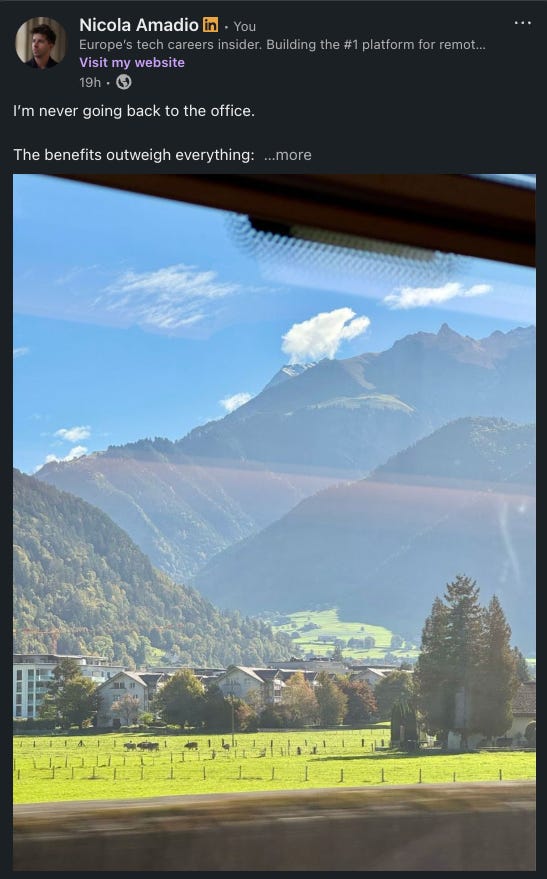
If, back when I started my newsletter and business, I knew what I know now about top-paying remote tech careers…
I might have chosen that path over of my current one.
Quick reminder on how my journey went:
Climbed my way up to a big tech job in Zurich
Felt like sharing all things I’d learnt on tech careers in Europe
Fell in love with the process, which coupled several of my passions and skillsets
Validated with early products: coaching program, job board
While I had an ‘urge’ to start with the newsletter and everything else that followed, and despite having more fun with that than in my dev jobs…
I’m not sure online businesses are worth the upfront work & risk required for them to work, compared to just chasing remote tech careers instead.
I think the “indie hacking” / “SaaS founder” trend on Twitter/X is a fad.
I’ve seen some people in my coaching program chase it and fail, while others were just killing it getting 6 figures remote tech jobs that offered something quite similar, at the end of the day.
I think 90% of people making money with SaaS as solopreneurs are content creators with a good enough audience.
If you want to get into the field of online business, I recommend starting with that: build an audience.
It doesn’t have to be big, especially if you’re doing B2B, but it should be at least a few thousands people that learn from you, respect you and would trust you with some of their money.
How hard it is to build an online business, is gonna depend on your skillsets and the market for them, but, generally, it’s much harder than getting a top tech jobs.
I feel like it’s also quite a bit more luck-dependant: what you know, are good at and your communication style need to fit well with some “gap in the market”.
You can strategise it a bit, but the magnitude of the response is to a non-small extent luck-based (I think).
If that’s what you like, though, you can work towards it.
It’s not impossible, nor stupid.
Working for yourself has pros and cons compared to working for someone
For some people it might be a better fit.
For me, for example, I think it’s better.
One of the main reasons for this is that I can’t get to care enough about someone else’s product, to do my best at it.
Ways in which solopreneur > corporate worker (for me)
Maybe it’s because I only worked for big companies, where the reward was a promotion which is anyway largely tenure-based, and which anyway won’t yield outsized impact, considering also how income tax rates are set to effectively screw high-earners.
Another aspect of big companies is that you’re obviously just a number, so you don’t get to really care about the people owning the company and/or working with you (cause sure as hell they don’t care about you).
Maybe, working for a smaller company, with a bonus-skewed compensation package, maybe even on a revenue-share basis, could have worked better for me (a bit like how people in sales or trading are paid).
The advantages of solopreneurship don’t quite justify the effort required
It’s very hard to build a business, even a small one.
A six-figure remote job really is an amazing deal, especially if you like actually building.
Being an engineer (or data engineer, or MLE, or PM, etc) is a CRAFT.
In a domain. With clearcut skillsets.
Being an entrepreneur is a bit like being a hustler and doing everything that’s required to bring in the result, regardless of how fancy or interesting it is.
Building EuroTopTech, I am much more motivated than working on the biggest database in the world or building the tech behind the world’s most advanced logistics system, but let’s be honest: tech and product wise, they don’t even compare 😄
I am more motivated here because I’m the only one running the show, it’s a product I created out of my inner ideas and passions and interests, so in that sense it’s very rewarding.
Also, what I do has an extreme high-impact on the product success or failure. Which adds to the pressure/motivation.
But, to be fair, it can also be very rewarding to work on a cool, large-scale and/or very innovative product.
Especially if you get paid handsomely for it, with good perks and a respectful WLB.
Here’s what I would do today
If I were to start over, here’s what I would do:
1. Get some cash while learning
Can be onsite, remote, hybrid, big tech, startup - doesn’t even matter that much.
The important thing is to build a 5 to 6 figure saving pot while learning things that are useful and interesting to you.
2. Get a flexible job
If you want to keep stacking up cash and/or having high purchasing power, get a six-figure remote job.
If you already got some money and your priorities have shifted, you can even take a lower paid job that allows you to have the life and lifestyle that you want.
3. Build your projects
Now, your projects can be anything really:
A newsletter
A YouTube channel
Little SaaS tools
Open-source contributions
B2B client work (kinda like consulting)
Writing a book
A creative / hobby project
You name it.
As you build projects, you’ll learn what sparks you more or less: then you can listen to yourself, and do more of what lights you up.
All while having some security and an already fulfilling career on the back.
4. Lean into the idea of a “fluid job market”
The future is hybrid.
I wouldn’t even think too much in terms of being a business owner vs being an employee.
Today, everything is a bit mixed up.
You can create content, and through it get jobs, or clients for consulting work, or ideas for B2B products and services.
You can work on a project, spin it to a product, get acquired and become part of the leadership team for that product in a bigger company.
You can work in corporate, learn skills, share them and/or pivot while doing freelance stuff. And the, after the pivot, re-enter the job market.
It’s a fluid work market.
5. Beware of “dream sellers”
I would try to stay away from stereotypes and fads, and focus on the fundamentals: what you like, what you’re good at, concrete features that a job or a business would give you, etc.
Don’t put things into boxes (like “building a SaaS and travelling the world”, “working in big tech Zurich”, “being a six figure remote worker”), and then assess them at face value.
People out there need to create “dreams” - as clearly defined as possible - for people to buy into them (and then buy the product that will lead them to that “dream life”).
I do it too!
I believe in the products I build, and in the things I say.
I try to contextualise why I think these things are good, giving you details and so on.
But still, I am selling something.
It’s good if I make something that I sell sound appealing.
I’m never going to build a product to help you land an onsite job in Milan, because I think that, out of all paths, it’s not quite a great one to aim for.
But maybe it is! For some people, that might be a perfectly fine life.
(maybe these people will end up being so happy about it, that they’ll create content and sell products to others who buy into that dream to help them get that outcome)
As you see, it’s a matter of perspective.
Create your own path.
This article is brought to you by:
Euro Top Tech - The #1 resource for landing Top-Paying Tech roles in Europe:
2000+ top paying tech jobs in Europe from big tech companies, HFT firms and high-paying scale-ups.
1000+ jobs from 100+ fully-remote companies paying $100-600k per year.
Private guides - like this one - to help you land these jobs.
Six Figure Euro Engineer - Maximise your chances to boost your Tech Career in Europe, reducing time to success:
Work 1:1 with me (Nicola Amadio, author of this newsletter), and join the other engineers who were able to 10x their tech career in the past few months!
“the magnitude of the response is to a non-small extent luck-based (I think).” <- this is what 99% of people gets wrong when they get into the “creator” business. They think that making good, useful content is all it takes. When that’s the bare minimum. Luck and unfair advantages play a crucial role.